

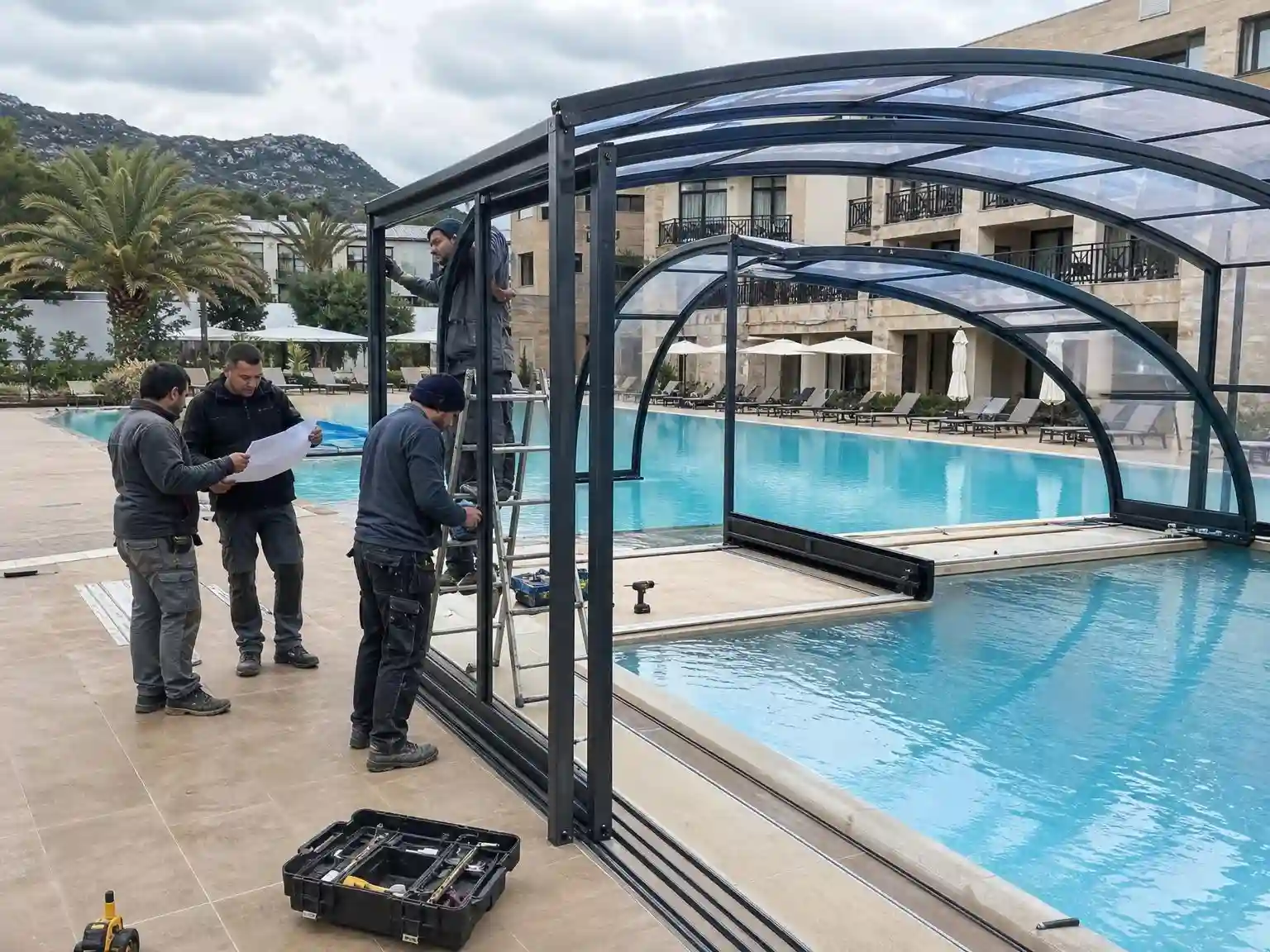
Pool Enclosure Installation Guide: Measurement, Foundation, Drainage and Local Support
Installing a pool enclosure is not only about covering a swimming pool. A successful pool enclosure project requires accurate site measurement, proper foundation preparation, drainage planning, track alignment, material selection and coordination with local installers.
For retractable pool enclosures, telescopic pool enclosures and custom swimming pool enclosure systems, installation quality directly affects daily operation, weather protection, safety, appearance and long-term performance.
This guide explains the key steps of pool enclosure installation and how Sunrim supports global pool enclosure projects with measurement guidance, technical drawings, local contractor coordination and optional on-site installation assistance for selected projects.
If you are still comparing different outdoor enclosure options, you may first read our guide on how to choose a retractable sunroom or opening roof system for commercial outdoor spaces.
Quick Answer: What Is the Most Important Part of Pool Enclosure Installation?
The most important part of pool enclosure installation is accurate site preparation before production begins.
Before ordering a custom pool enclosure, the project team should confirm the pool size, deck condition, foundation strength, drainage direction, track position, opening method, local climate requirements and installation access.
For retractable or telescopic pool enclosures, track alignment is especially important because the enclosure sections need to slide smoothly and safely over the swimming pool area.
A pool enclosure should not be treated as a simple pool cover. It is a customized architectural structure that must match the pool, surrounding deck, local weather and long-term usage requirements.
What Is a Pool Enclosure Installation?
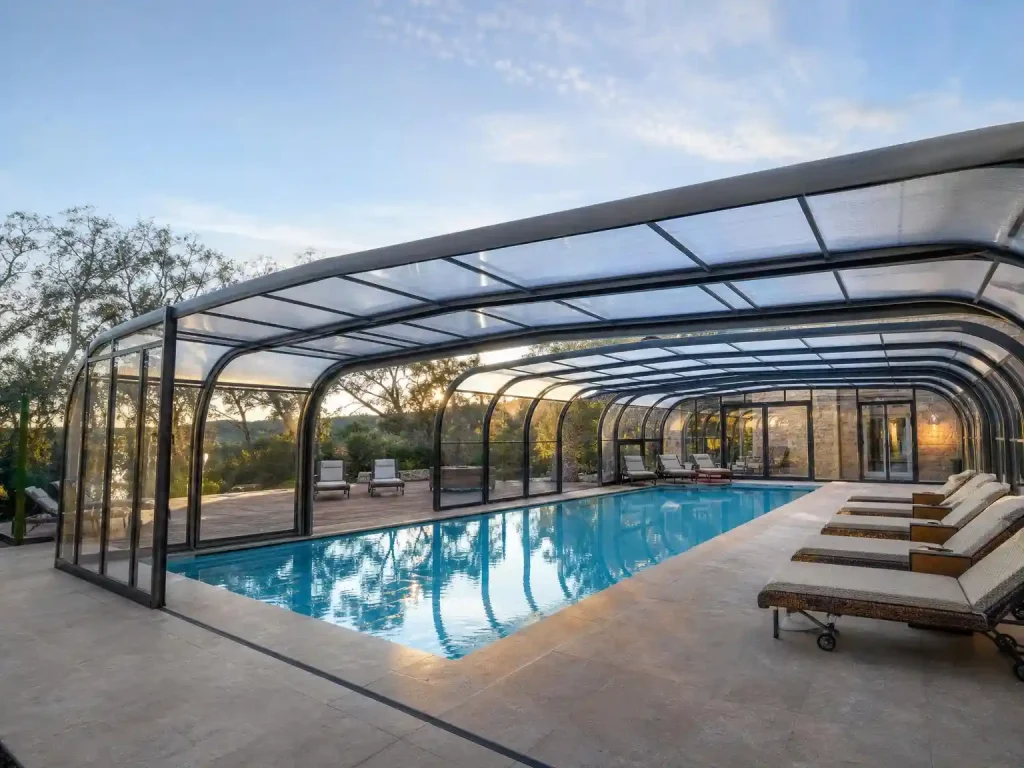
A pool enclosure installation is the process of assembling and fixing an enclosure structure around or above a swimming pool. Depending on the design, the system may include aluminum frames, transparent glass or polycarbonate panels, sliding tracks, wheels, seals, drainage components, locking systems and optional motorized operation.
Common pool enclosure types include:
- Retractable pool enclosures
- Telescopic pool enclosures
- Low-profile pool enclosures
- High-profile pool enclosures
- Pool sunroom enclosures
- Fixed pool enclosure structures
- Motorized pool enclosure systems
- Commercial swimming pool enclosures
A retractable pool enclosure can open and close based on weather and usage needs. This makes it suitable for outdoor pools, hotel pools, resort pools, private villas, wellness centers and commercial leisure spaces.
Why Proper Installation Matters
A pool enclosure is exposed to moisture, wind, sunlight, temperature changes and daily movement. If the installation is not planned correctly, problems may appear later.
Common problems caused by poor installation include:
- Difficult sliding or track misalignment
- Water accumulation around the pool deck
- Leakage at connection points
- Poor wind resistance
- Uneven structure movement
- Damaged rollers or tracks
- Inaccurate panel fitting
- Drainage problems
- Safety risks during operation
- Shortened system service life
For commercial pool projects, installation quality also affects guest experience and business operation. Hotels, resorts and public pool facilities need a reliable enclosure that can perform under frequent use.
Step 1: Confirm the Pool Type and Project Purpose
Before installation planning begins, define how the pool enclosure will be used.
Different pool projects require different design and installation approaches.
Common project types include:
- Private residential swimming pools
- Hotel outdoor pools
- Resort leisure pools
- Indoor-outdoor pool areas
- Wellness center pools
- Public swimming pools
- School or community pools
- Poolside commercial leisure spaces
A residential pool may focus on family use, safety and seasonal protection. A hotel pool may require premium appearance, guest comfort and easy daily operation. A resort pool may need larger spans, better views and stronger weather protection.
Before choosing the enclosure system, ask:
- Is the pool used privately or commercially?
- Should the enclosure be low-profile or walk-in height?
- Does the pool need full or partial opening?
- Is manual or motorized operation preferred?
- Will guests swim under the closed enclosure?
- Is wind, rain, snow, heat or humidity a major concern?
- Will local contractors handle installation?
- Is on-site technical support required?
These answers help determine the enclosure structure, track layout and installation method.
Step 2: Measure the Pool and Surrounding Deck Area
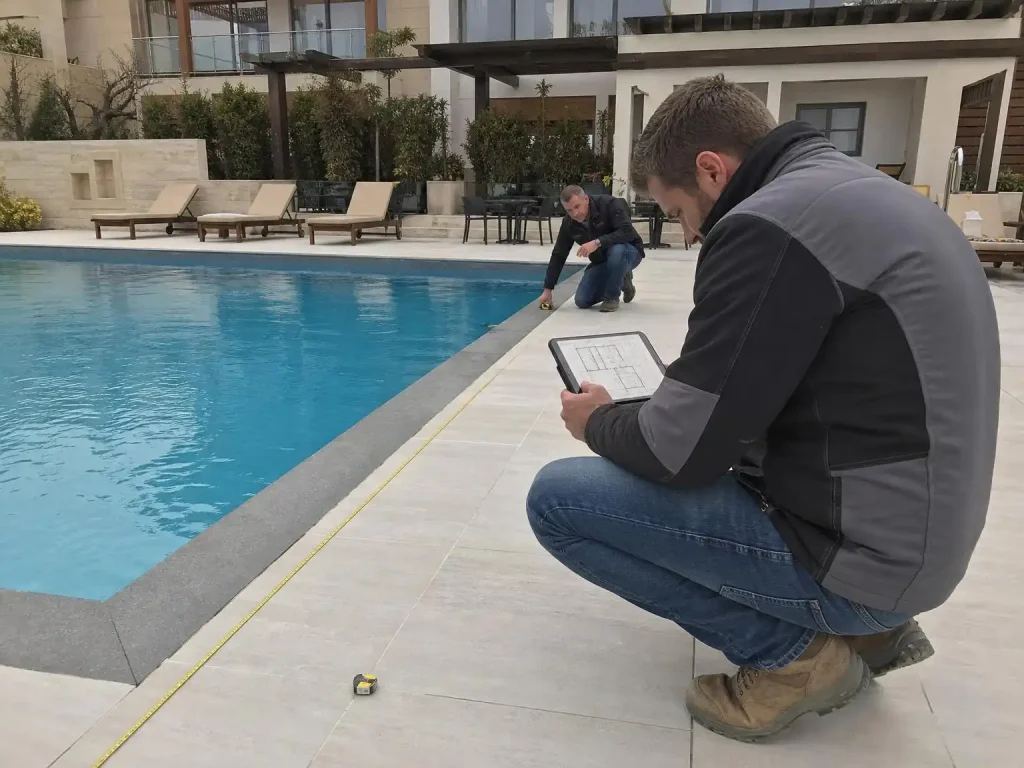
Accurate measurement is the foundation of a custom pool enclosure project.
For a retractable pool enclosure, the measurement should not only include the swimming pool itself. The surrounding deck, track area, clearance space and possible obstacles must also be checked.
주요 측정 항목은 다음과 같습니다:
- Pool length
- Pool width
- 수영장 형태
- Surrounding deck width
- Available sliding direction
- Total enclosure coverage area
- Height requirement
- 지반 경사
- Deck levelness
- Distance to nearby walls, fences or buildings
- 배수 방향
- Pool equipment location
- Existing railings, steps or landscaping
- Access path for installation materials
For telescopic pool enclosures, extra space may be required at one end of the pool for stacked sections when the enclosure is opened.
Sunrim can provide measurement guidance, forms and drawing references to help customers or local contractors collect the required site data before design and production.
Step 3: Check Foundation and Track Support
The foundation or pool deck must be strong enough to support the enclosure structure and track system.
For retractable pool enclosures, tracks carry the movement of the enclosure sections. If the base is uneven, weak or unstable, the enclosure may not slide smoothly.
Foundation and support checks should include:
- 콘크리트 두께
- 표면 평탄도
- Deck cracks or settlement
- 앵커 강도
- Track support width
- Edge distance from the pool
- 배수 경사
- 내하중 능력
- Reinforcement requirements
- Long-term movement or expansion of the deck
Common support surfaces include:
- Reinforced concrete deck
- Existing pool patio
- Structural concrete slab
- Steel-supported platform
- Reinforced terrace structure
For lightweight residential systems, an existing pool deck may be sufficient if it is stable and level. For commercial pool enclosures, a local contractor or engineer should review the foundation condition before installation.
Step 4: Plan the Track Layout
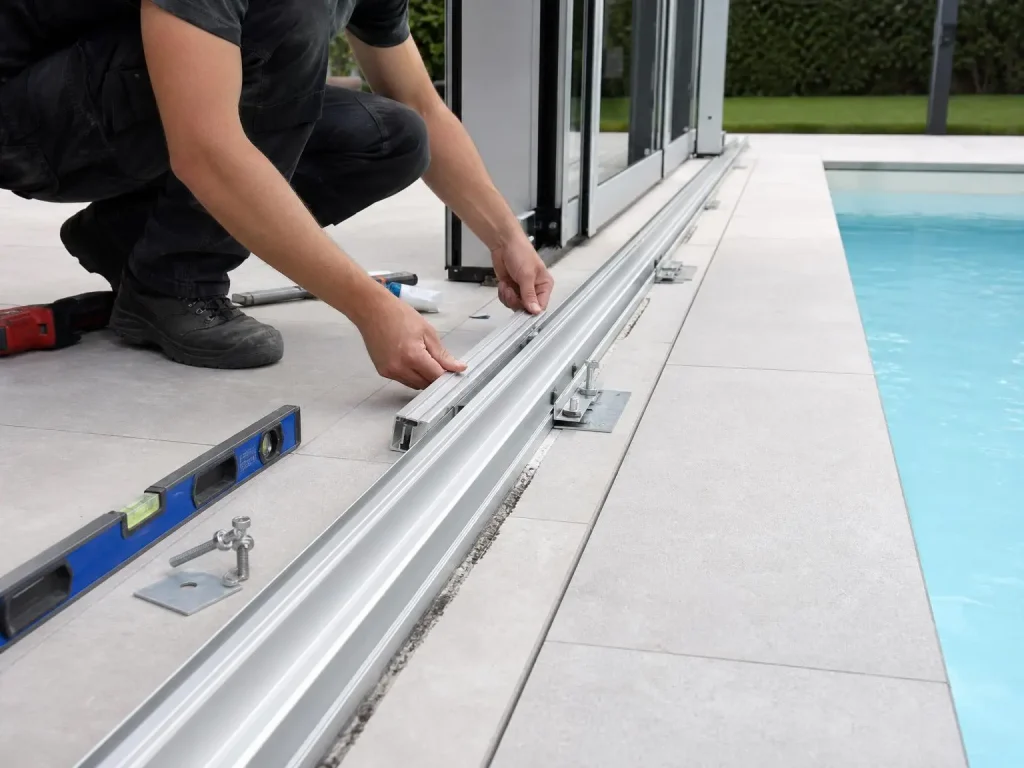
Track layout is one of the most important parts of retractable pool enclosure installation.
The track determines how the enclosure opens, closes and stacks. It also affects safety, appearance and long-term operation.
Track planning should consider:
- 미끄러짐 방향
- Number of enclosure sections
- Track length
- Track width
- 배수 경로
- End stop position
- 적재 공간
- Walking area around the pool
- Access to pool steps or ladders
- 유지보수 접근 권한
- Safety around children or guests
For hotel and resort pools, track placement should not interfere with guest circulation, lounge chairs or service areas.
For residential pools, the track should be positioned to balance usability, safety and appearance.
If the site does not have enough space for standard track layout, Sunrim can review the project and suggest a customized opening method.
Step 5: Plan Drainage Around the Pool Enclosure
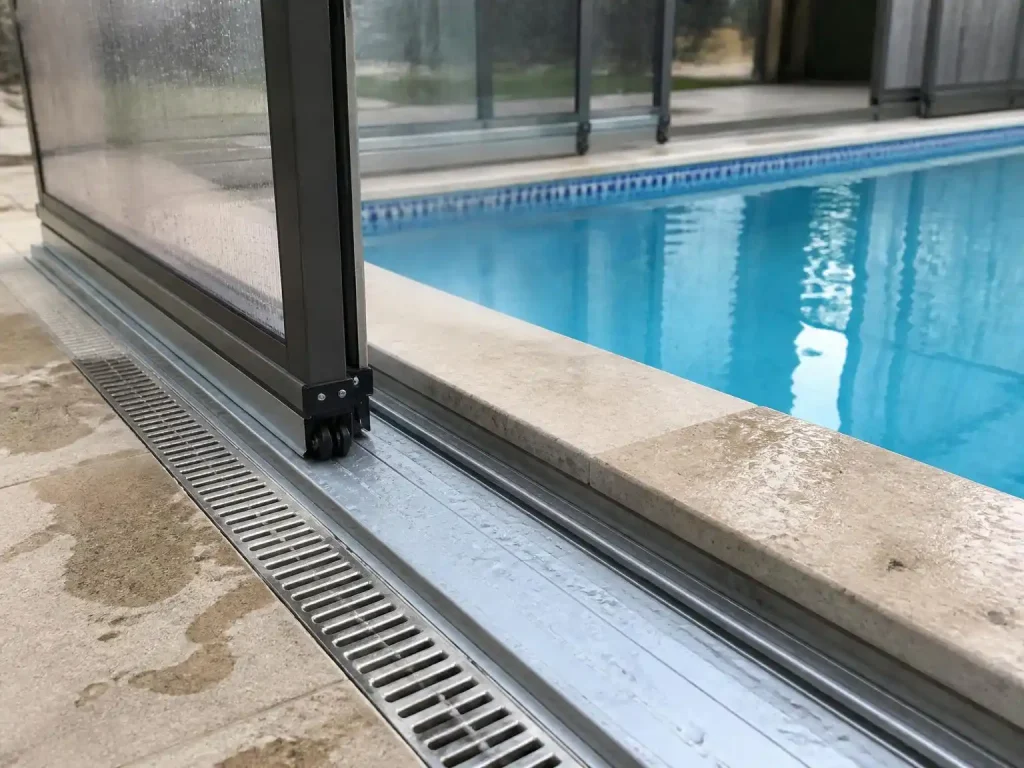
Drainage is critical for pool enclosure installation because the structure is constantly exposed to water from rain, pool splash, cleaning and condensation.
Poor drainage can cause water accumulation, slippery areas, leakage, corrosion and discomfort.
Drainage planning should include:
- Deck slope
- Rainwater direction
- 배수 경로
- Gutter or channel drainage
- Water discharge point
- Avoiding water flow into indoor areas
- Avoiding standing water beside tracks
- Managing condensation inside the enclosure
- Connection with existing site drainage
For rainy regions such as Singapore, Malaysia, Thailand, Florida and coastal Australia, drainage capacity should be reviewed carefully.
For colder regions such as Canada, northern United States, Germany and northern Europe, melting snow and freeze-thaw conditions should also be considered.
A good drainage plan should be made before production and installation, not corrected after leakage appears.
Step 6: Choose the Right Enclosure Height
Pool enclosures can be designed in different heights.
일반적인 옵션으로는 다음과 같은 것들이 있습니다:
- Low-profile pool enclosures
- Mid-height pool enclosures
- High-profile walk-in pool enclosures
- Pool sunroom-style enclosures
Low-Profile Pool Enclosure
A low-profile enclosure is often used when the owner wants a clean, discreet appearance. It helps protect the pool from debris, rain and heat loss, but it may not provide full walking height inside.
Best for:
- 주택용 수영장
- Private gardens
- Smaller outdoor pools
- Projects where visual impact should be reduced
High-Profile Pool Enclosure
A high-profile enclosure allows people to walk, sit or swim under the structure when it is closed.
Best for:
- 호텔 수영장
- 리조트 수영장
- Commercial leisure spaces
- 연중 수영장 이용
- Poolside lounge areas
Pool Sunroom Enclosure
A pool sunroom enclosure creates a more enclosed indoor-outdoor environment. It may include higher aluminum frames, transparent roof panels, side panels, doors and optional ventilation.
Best for:
- 고급 빌라
- 호텔
- 리조트
- 웰니스 센터
- Cold or windy regions
The right height depends on the project purpose, budget, appearance and how the space will be used.
Step 7: Choose Glass or Polycarbonate Panels
Pool enclosure panels are usually made from glass or polycarbonate. Both materials can be used, but they perform differently.
폴리카보네이트 패널
Polycarbonate is commonly used for retractable pool enclosures because it is lightweight, impact-resistant and suitable for curved or telescopic structures.
장점:
- 경량
- Impact-resistant
- Suitable for curved designs
- Better for movable sections
- 투명 또는 착색된 제품으로 제공됩니다
- Helps reduce structural load
고려 사항:
- May not look as premium as glass
- Surface quality and UV coating should be checked
- Cleaning should avoid abrasive tools
유리 패널
Glass provides a premium architectural appearance and clear visibility. It is often used for high-end hotel, villa or commercial pool projects.
장점:
- 투명도 제거
- 고급스러운 외관
- Strong visual quality
- 세척이 간편합니다
- Good for high-end projects
고려 사항:
- 폴리카보네이트보다 무겁다
- Requires stronger structure
- May increase cost
- Safety glass options should be considered
For most retractable pool enclosures, polycarbonate is often practical because it reduces weight and supports smooth movement. For premium pool sunroom enclosures, glass can be considered based on structure and budget.
Step 8: Consider Local Climate Conditions
A pool enclosure should be designed according to the local climate.
지역마다 우선순위가 다릅니다.
미국과 캐나다
For pool enclosure projects in the United States and Canada, wind load, snow load, swimming season extension and local building requirements are important considerations. In colder regions, the enclosure may help reduce heat loss and extend pool usability.
영국 및 유럽
For the United Kingdom, Germany, France, Italy, Spain and the Netherlands, pool enclosures often need to balance rain protection, natural light, seasonal temperature changes and architectural appearance.
호주와 뉴질랜드
For Australia and New Zealand, UV exposure, wind, coastal corrosion and outdoor lifestyle use are important. Coastal pool projects should consider corrosion-resistant aluminum finishes and stainless steel hardware.
중동
For the United Arab Emirates, Saudi Arabia and Qatar, strong sunlight, heat and dust are key factors. Tinted panels, ventilation and durable aluminum structures may be important for resort and hotel pool projects.
동남아시아
For Singapore, Malaysia and Thailand, heavy rain, humidity and ventilation are major concerns. Drainage design and moisture-resistant materials are especially important.
Designing around the local climate helps improve performance and reduce maintenance problems.
Step 9: Prepare Local Contractors for Installation
For most international pool enclosure projects, installation is completed through cooperation between Sunrim and local contractors.
Local contractors usually handle:
- 부지 조성
- 기초 공사
- Concrete or deck reinforcement
- Lifting and installation labor
- 앵커링
- Electrical connection if motorized
- Sealant work
- 지역 건축 규정
- Final site cleaning
Sunrim can support the installation process with:
- Custom design drawings
- 구성 요소 목록
- 설치 설명서
- Track layout guidance
- 화상 통화 지원
- Technical communication with installers
- 설치 중 문제 해결
- Optional on-site assistance for selected projects
This cooperation model helps combine Sunrim’s product expertise with the local contractor’s knowledge of site conditions and local building practices.
Step 10: Remote Guidance and On-Site Installation Support
Many customers ask whether an overseas supplier can help with installation.
Yes. Sunrim can provide different levels of support depending on project complexity.
원격 설치 안내
Remote support may be enough when the site is simple and the local contractor has construction experience.
It can include:
- Measurement instructions
- CAD 도면
- 설치 설명서
- Packing lists
- Component identification
- Video meeting support
- Track installation guidance
- Motorized system guidance
- 최종 점검 체크리스트
On-Site Measurement or Installation Assistance
For selected commercial or complex pool enclosure projects, Sunrim can arrange technical personnel to assist with on-site measurement, installation guidance and coordination with local contractors, depending on project location and schedule.
On-site support may be useful for:
- Hotel pool enclosure projects
- Resort pool enclosure projects
- Large commercial swimming pools
- Complex telescopic structures
- Projects with strict installation timelines
- Projects where the local contractor has limited experience
- Projects that require detailed site measurement before production
This service helps reduce communication errors and improve installation confidence for overseas customers.
Common Pool Enclosure Installation Problems
Many installation problems can be avoided if they are considered early.
Problem 1: Inaccurate Measurement
If the pool, deck or track area is measured incorrectly, the enclosure may not fit properly.
Solution: Provide accurate dimensions, photos, videos, drawings and diagonal measurements before production.
Problem 2: Weak or Uneven Foundation
If the deck is not level or strong enough, the track may shift or the enclosure may become difficult to operate.
Solution: Review foundation condition and reinforce the base if needed.
Problem 3: Poor Track Alignment
Track misalignment can cause difficult sliding, noise and long-term wear.
Solution: Follow track layout drawings carefully and check alignment during installation.
Problem 4: Drainage Problems
Blocked or poorly planned drainage can cause water accumulation around the enclosure.
Solution: Plan deck slope, track drainage and discharge points before installation.
Problem 5: Lack of Installation Access
Large enclosure sections need space for unloading, lifting and assembly.
Solution: Confirm access routes, lifting equipment and storage space before shipment.
Problem 6: Incorrect Local Contractor Preparation
If the local installer does not understand the system, installation may be delayed.
Solution: Review drawings, manuals and installation sequence with Sunrim before installation starts.
Installation Preparation Checklist
Before installation begins, review the following checklist:
- Pool dimensions are confirmed
- Deck area is measured
- Track layout is approved
- Foundation condition is checked
- 배수 방향이 계획되어 있습니다
- Enclosure height is confirmed
- Material selection is finalized
- Local climate requirements are reviewed
- 현지 시공사 선정 완료
- Installation drawings are shared
- Tools and lifting equipment are prepared
- Electrical access is ready if motorized
- Product packing list is checked
- Installation sequence is understood
- Final inspection plan is prepared
A clear checklist helps reduce installation delays and project risks.
Maintenance After Installation
After the pool enclosure is installed, regular maintenance helps keep the system working smoothly.
Basic maintenance includes:
- Cleaning roof panels
- Removing debris from tracks
- Checking rollers and moving parts
- 씰 점검
- 배수구 청소
- Testing motorized operation
- Checking fasteners after storms
- Rinsing frames in coastal areas
- Avoiding operation when tracks are blocked
For commercial pool enclosures, maintenance should be included in the facility management schedule.
How Sunrim Supports Pool Enclosure Projects
Sunrim provides custom retractable pool enclosure systems, pool sunroom enclosures and commercial movable enclosure solutions for global projects.
Our project support can include:
- 프로젝트 초기 상담
- 측정 지침
- Custom design
- CAD 도면
- 재료 권장 사항
- Foundation and track layout suggestions
- Drainage planning support
- 제조 및 품질 관리
- 설치 설명서
- Remote video support
- 현지 시공사와의 협력
- Optional on-site measurement or installation assistance for selected projects
Whether your project is a residential pool, hotel pool, resort pool, public swimming pool or commercial leisure facility, Sunrim can help design a pool enclosure system based on your site, climate and usage needs.
결론
A successful pool enclosure installation depends on much more than the enclosure product itself. Accurate measurement, stable foundation, proper track layout, drainage planning, climate-based design and local contractor coordination all play important roles.
For retractable and telescopic pool enclosures, installation quality directly affects smooth movement, weather protection, safety and long-term performance.
Sunrim supports global customers with custom pool enclosure design, technical drawings, measurement guidance, installation manuals, remote support and optional on-site assistance for selected projects.
If you are planning a custom pool enclosure project, prepare your pool dimensions, site photos, deck condition, project location and application type. Our team can help evaluate your project and recommend a suitable enclosure solution.
Need Help with Your Pool Enclosure Installation?
Sunrim designs and manufactures custom retractable pool enclosures, pool sunroom enclosures and commercial movable enclosure systems for global projects.
Send us your pool size, site photos, project location and installation requirements. Our team can provide technical recommendations, design support and installation guidance for your local contractor.
Sunrim에 문의하기 to discuss your custom pool enclosure installation project.
FAQ About Pool Enclosure Installation
What is the most important part of pool enclosure installation?
The most important part is accurate site preparation, including pool measurement, deck condition, foundation strength, track layout, drainage direction and local climate requirements.
Can a pool enclosure be installed on an existing pool deck?
Yes, a pool enclosure can often be installed on an existing pool deck if the surface is stable, level and strong enough for anchoring and track support.
Does a retractable pool enclosure need tracks?
Most retractable and telescopic pool enclosures use tracks to guide movement. Track alignment is very important for smooth opening and closing.
What foundation is needed for a pool enclosure?
A stable concrete deck, reinforced slab or structural support is usually needed. The exact requirement depends on enclosure size, weight, wind conditions and site structure.
How should drainage be planned for a pool enclosure?
Drainage should consider deck slope, track drainage, gutter channels, water discharge direction and heavy rain conditions. Poor drainage can cause water accumulation and leakage problems.
Can Sunrim help local contractors install the pool enclosure?
네. Sunrim은 기술 도면, 설치 매뉴얼, 동영상 안내 및 원격 지원을 제공할 수 있습니다. 또한 일부 복잡한 프로젝트의 경우, Sunrim은 현장 설치 지원도 마련해 드릴 수 있습니다.
Can Sunrim visit the site for measurement?
For selected commercial or complex projects, Sunrim can arrange technical personnel to assist with on-site measurement depending on project location, schedule and project requirements.
Is polycarbonate or glass better for pool enclosures?
Polycarbonate is lightweight and suitable for many retractable pool enclosure systems. Glass provides a premium appearance but is heavier and may require stronger structure.
Are pool enclosures suitable for snowy regions?
Yes, but snow load, structure strength, roof slope and winter maintenance should be considered during design.
Are pool enclosures suitable for coastal areas?
Yes. Coastal pool enclosures should use corrosion-resistant aluminum finishes, stainless steel hardware and regular maintenance because salt air can affect metal parts.
Can a pool enclosure be motorized?
Yes. Some pool enclosure systems can be designed with motorized operation depending on size, structure and project requirements.
견적 요청 전에 어떤 정보를 준비해야 하나요?
Prepare pool length, pool width, deck dimensions, site photos, project location, desired enclosure height, opening direction, local climate information and installation requirements.


