

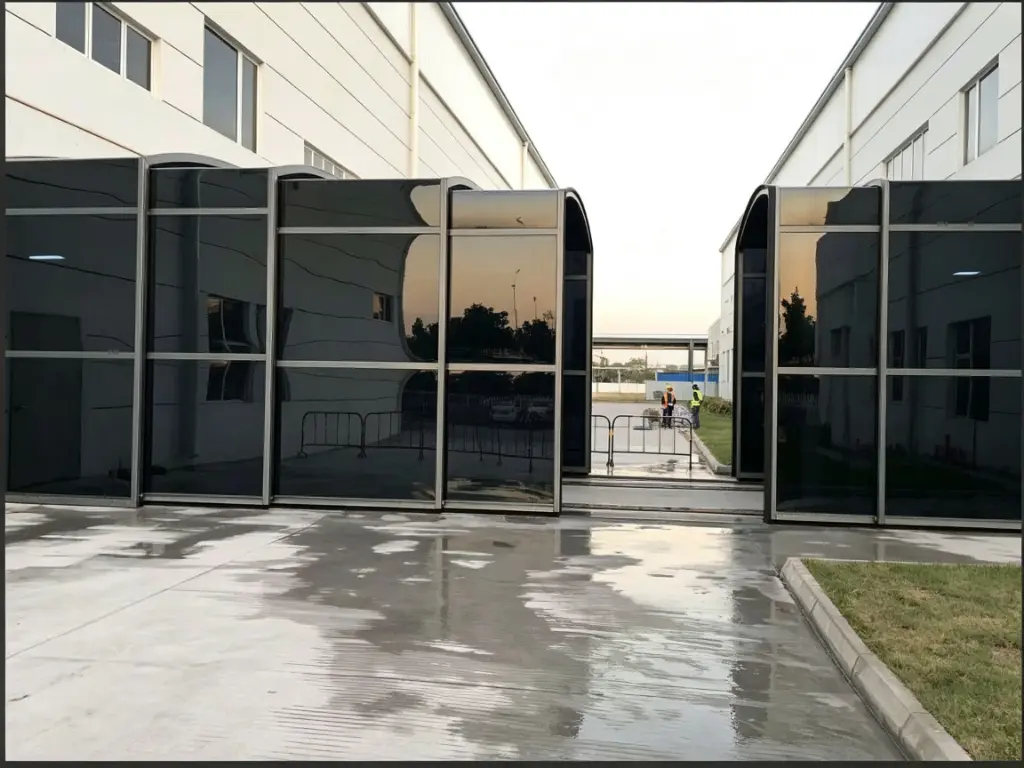
Passerelle industrielle rétractable pour quais de chargement et liaisons entre usines
An industrial retractable walkway is a flexible weatherproof corridor system designed for factories, warehouses, logistics centers and loading areas. It helps protect workers, goods and equipment from rain, wind, sunlight, dust and changing outdoor conditions while keeping industrial sites open and accessible when needed.
In many factories and industrial parks, production workshops, warehouses, office blocks, loading docks and equipment rooms are located in separate buildings. People and materials often need to move between these areas every day. Without proper protection, outdoor passages can become wet, slippery, uncomfortable or inefficient during bad weather.
A retractable walkway system solves this problem by creating a movable corridor enclosure. When weather protection is required, the walkway can be extended to cover the passage. When larger access, ventilation or equipment movement is needed, the system can be retracted.
For industrial facilities, this flexibility is especially valuable. Unlike a fixed canopy or permanent corridor, an industrial retractable walkway can support both weather protection and operational access.
Sunrim designs and manufactures custom industrial retractable walkway systems for factories, warehouses, logistics centers, loading dock areas and production facilities worldwide.
Quick Answer: What Is an Industrial Retractable Walkway?
An industrial retractable walkway is a movable covered corridor system used to connect factory buildings, warehouses, workshops, loading docks and outdoor work areas. It can extend to provide rain, wind and sun protection, and retract when open access is required for vehicles, forklifts, ventilation or equipment movement.
A typical industrial retractable walkway includes an aluminum frame, roof panels, sliding or telescopic modules, track system, drainage design, sealing system and manual or motorized operation.
For factory and logistics projects, Sunrim provides industrial retractable walkway systems designed for safe, flexible and weather-protected building connections.
Why Factories Need Weatherproof Walkway Systems
Industrial sites often have outdoor circulation routes between different buildings and work zones. These routes may be used by workers, supervisors, maintenance teams, material handlers, quality inspection staff and logistics operators.
When these routes are exposed to weather, several problems can occur:
- Workers may be exposed to rain, wind or strong sunlight
- Outdoor walkways may become slippery
- Materials may get wet during transfer
- Packaging may be damaged by rain
- Loading operations may be delayed
- Equipment movement may become less efficient
- Workplace safety risks may increase
- Temporary covers may not provide enough protection
A weatherproof walkway helps reduce these problems by creating a more controlled passage between buildings.
However, industrial facilities also need flexibility. Fixed corridors may block vehicle access, limit equipment movement or interfere with site operations. This is why a retractable walkway can be more practical than a permanent structure in many industrial environments.
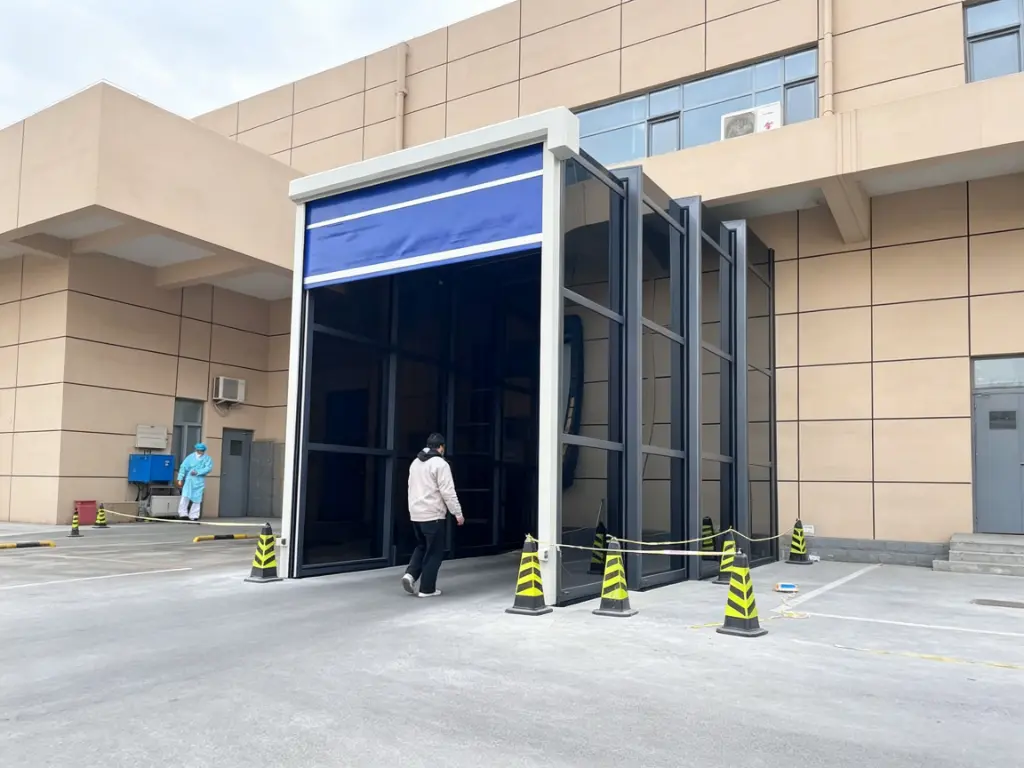
Main Industrial Applications of Retractable Walkways
1. Factory Building Connections
One of the most common applications is connecting two or more factory buildings.
Many industrial campuses include separate areas for:
- Production workshops
- Warehouses
- Assembly areas
- Packaging rooms
- Quality inspection zones
- Office blocks
- Maintenance rooms
- Equipment storage areas
An industrial retractable walkway can create a protected route between these buildings.
When closed, it helps workers and materials move safely during rain or strong sunlight. When opened, it allows more ventilation, easier equipment access and better use of the outdoor yard.
For a broader overview of factory corridor applications, see Sunrim’s industrial retractable walkway system application page.
2. Loading Dock Retractable Walkway
Loading docks are often exposed to weather. Rain and wind can affect goods transfer, packaging quality and worker comfort.
A loading dock retractable walkway can create a covered passage for loading and unloading operations.
Il convient pour :
- Truck loading zones
- Warehouse loading docks
- Goods receiving areas
- Material transfer routes
- Distribution centers
- Logistics platforms
- Factory shipping areas
- Temporary loading passages
When extended, the walkway provides weather protection for goods and workers. When retracted, it helps preserve clearance for trucks, forklifts and loading equipment.
This makes the loading dock retractable walkway useful for facilities where weather protection is needed, but full-time enclosure would reduce operational flexibility.
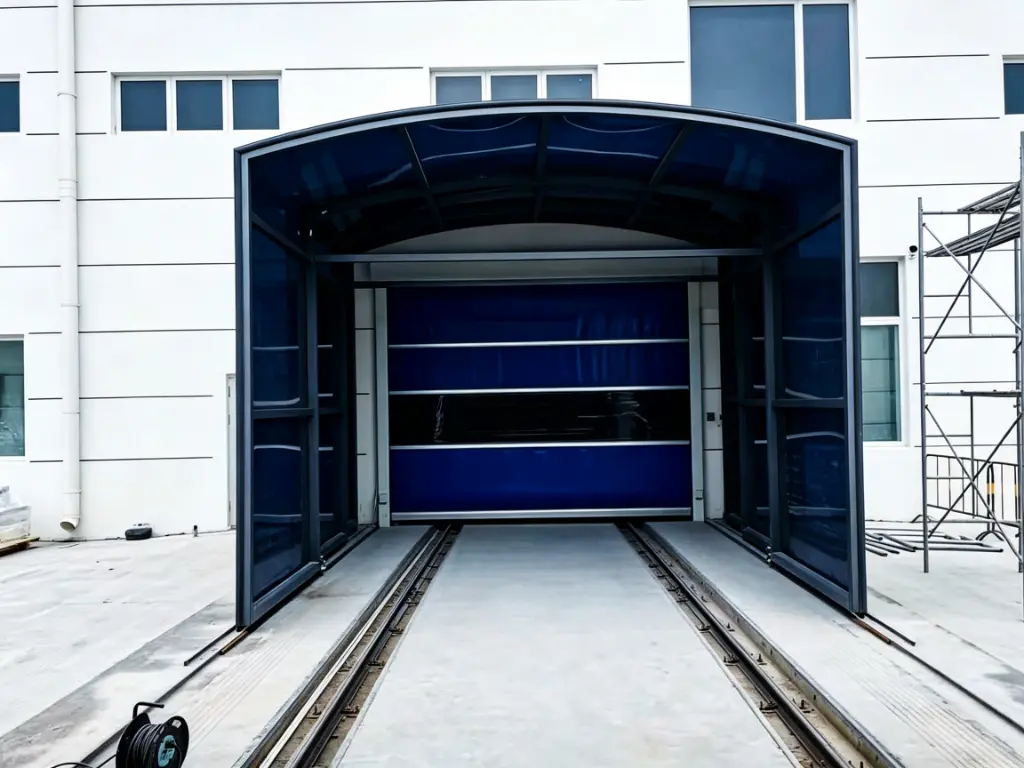
3. Warehouse-to-Workshop Passageways
Warehouses and workshops are often connected by outdoor routes. Materials may need to move from storage areas into production workshops several times a day.
A retractable walkway system can help protect these material transfer routes.
It can be used between:
- Raw material warehouses and workshops
- Finished goods warehouses and packaging areas
- Cold storage areas and logistics zones
- Production halls and inspection rooms
- Storage buildings and loading docks
For warehouses, the main value is reducing weather-related disruption while keeping the route flexible for different daily operations.
4. Logistics Center Walkway Covers
Logistics centers require fast and reliable movement of goods, people and equipment.
A retractable corridor enclosure can help create protected passages between loading zones, sorting areas, storage buildings and office blocks.
Common logistics applications include:
- Distribution center corridors
- Sorting facility connections
- Outdoor goods transfer passages
- Covered access between logistics buildings
- Temporary weather protection for seasonal operations
- Walkway protection between staff areas and warehouses
For logistics operations, time and efficiency matter. A retractable walkway can reduce weather interruptions without permanently blocking access routes.
5. Industrial Park Pedestrian Corridors
Large industrial parks often include multiple factory buildings and shared outdoor routes.
A retractable walkway can help create safer and more comfortable pedestrian circulation for:
- Workers
- Visitors
- Supervisors
- Maintenance teams
- Security staff
- Office employees
This is especially useful when workers need to walk between office buildings, production buildings and warehouse areas during rain or hot weather.
6. Equipment Maintenance Access Areas
Some industrial facilities require protected access to equipment rooms, utility areas or maintenance zones.
A retractable walkway can provide temporary coverage during maintenance operations while allowing the area to remain open when not in use.
This can be useful for:
- Outdoor equipment rooms
- Utility buildings
- Maintenance access paths
- Mechanical service areas
- Energy or power facility access routes
Because the system can retract, it may allow better access for large maintenance equipment when required.
Benefits of Industrial Retractable Walkway Systems
1. Weather Protection for Workers and Goods
The most direct benefit of an industrial retractable walkway is weather protection.
It helps protect against:
- Pluie
- Vent
- Neige
- Un ensoleillement intense
- Poussière
- Les feuilles qui tombent
- Débris à l'extérieur
For workers, this improves comfort and safety.
For goods, it helps reduce exposure during transfer.
2. Flexible Access for Vehicles and Equipment
Industrial sites often need access for trucks, forklifts, carts, cranes or maintenance equipment.
A fixed canopy may create height or width limitations. A retractable walkway can be opened when more clearance is needed.
This flexibility is important for:
- Loading docks
- Factory yards
- Equipment maintenance areas
- Logistics passages
- Temporary transfer routes
- Sites with changing operational layouts
3. Improved Workplace Safety
Wet outdoor passages can increase slipping risks. Strong sun, rain or wind can also reduce comfort and visibility.
A covered industrial walkway can help improve daily movement and reduce exposure to harsh weather.
Safety-related benefits include:
- Reduced rain exposure on walking routes
- Better controlled pedestrian circulation
- More comfortable movement between buildings
- Less direct weather impact on materials
- Improved access during rainy seasons
4. Better Material Transfer Efficiency
When goods are moved between buildings, weather can slow down operations.
A retractable walkway can support smoother transfer by providing a protected route when needed.
This is useful for:
- Packaging materials
- Finished products
- Raw materials
- Components
- Tools
- Equipment
- Documents and inspection samples
5. More Practical Than Temporary Covers
Temporary tents, tarps or fabric covers may work for short-term use, but they often lack durability, appearance and stability for industrial facilities.
A retractable walkway system offers a more professional solution with:
- Stronger structure
- Better weather resistance
- Custom engineering
- Longer service life
- Better appearance
- Optional motorized operation
- Better integration with site layout
6. Better Than a Fixed Corridor in Flexible Industrial Sites
A fixed corridor may be suitable when the passage should always remain covered. But in many factories, full-time coverage may interfere with site operations.
A retractable walkway is better when the project needs:
- Weather protection during rain
- Open access during equipment movement
- Better ventilation
- Temporary or seasonal coverage
- Flexible clearance
- Adaptable outdoor space
Industrial Retractable Walkway vs Fixed Canopy
| Facteur | Fixed Industrial Canopy | Industrial Retractable Walkway |
|---|---|---|
| Protection contre les intempéries | Permanent | Flexible |
| Vehicle access | May be limited | Better when retracted |
| Equipment movement | May be restricted | More flexible |
| Ventilation | Limité | Better when opened |
| Installation purpose | Constant coverage | Adjustable coverage |
| Operation flexibility | Faible | Élevé |
| Idéal pour | Always-covered routes | Sites needing both protection and access |
A fixed canopy may be enough for simple pedestrian routes.
An industrial retractable walkway is more suitable when the site requires both weather protection and operational flexibility.
Industrial Retractable Walkway vs Temporary Tent
| Fonctionnalité | Industrial Retractable Walkway | Temporary Tent |
|---|---|---|
| Durability | Élevé | Low to medium |
| Industrial appearance | Professional | Temporary |
| Weather resistance | Stronger | Limité |
| Fonctionnement motorisé | Available | Usually not available |
| Custom size | Oui | Limité |
| Long-term use | Suitable | Not ideal |
| Stabilité structurelle | Higher | Lower |
For long-term factory and loading dock use, a retractable walkway is usually a better investment than temporary covers.
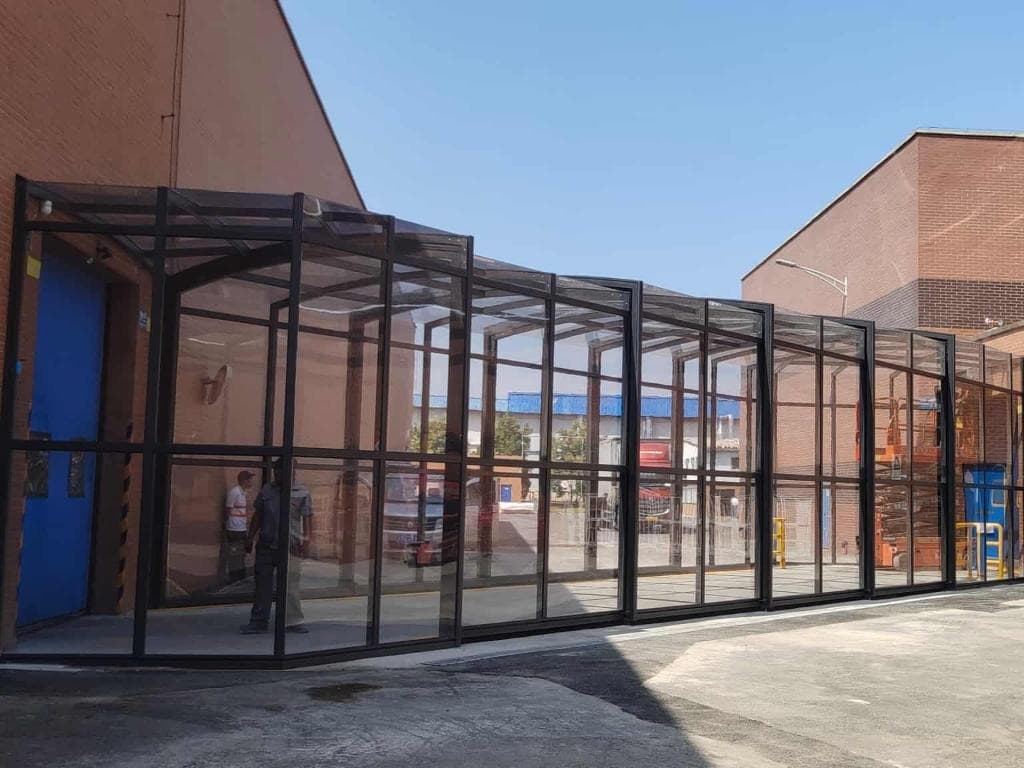
Key Components of an Industrial Retractable Walkway
1. Aluminum Frame Structure
Industrial retractable walkways usually use strong aluminum frames or custom structural profiles.
Aluminum offers several advantages:
- Résistance à la corrosion
- Long outdoor service life
- Lower weight than many steel structures
- Clean appearance
- Custom color options
- Suitable for modular systems
- Good performance in outdoor environments
For industrial projects, the frame should be designed according to walkway span, wind load, roof material and daily use requirements.
2. Roof Panel Materials
Roof panels can be selected based on project needs.
Parmi les options courantes, on trouve :
- Panneaux en polycarbonate
- Panneaux en verre trempé
- Solid roof panels
- Insulated roof panels
- Aluminum composite panels
Polycarbonate panels are lightweight and impact-resistant.
Glass panels provide higher transparency and a premium look.
Solid panels may provide stronger shading and privacy.
For industrial sites, material selection should consider durability, impact resistance, weight, light transmission and maintenance.
3. Retractable Sliding Modules
The movable system may use sliding or telescopic modules that move along rails.
The module design depends on:
- Walkway length
- Required opening distance
- Tracé du circuit
- Forme du toit
- Structural span
- Operation method
- Site clearance
The goal is to provide smooth movement while keeping the structure stable and weather-resistant.
4. Manual or Motorized Operation
Small walkway systems may use manual operation. Larger industrial systems usually benefit from motorized control.
Motorized options may include:
- Interrupteur mural
- Télécommande
- Control cabinet
- Système de commande intelligent
- Contrôle du groupe
- Safety limit control
A motorized retractable walkway is useful when the system is large, frequently operated or installed in a busy industrial environment.
5. Drainage and Sealing
Drainage is very important for industrial walkway systems.
A proper design should consider:
- Pente du toit
- Gutter design
- Drainage outlet
- Downpipe location
- Drainage des pistes
- Module overlap
- Bandes d'étanchéité
- Wind-driven rain
- Maintenance access
Poor drainage can cause water leakage, slippery floors and operational problems.
6. Optional Side Enclosure
Some industrial sites need only overhead protection. Others require side protection against wind, rain or dust.
Optional side enclosures may include:
- Fixed side panels
- Panneaux latéraux coulissants
- Polycarbonate side walls
- Glass side panels
- Partial wind screens
- Transparent side enclosures
For loading docks and exposed factory corridors, side protection can improve performance during wind-driven rain.
Design Considerations for Factories and Loading Docks
1. Site Layout
The walkway should fit the actual site layout.
Important questions include:
- Which buildings need to be connected?
- Is the walkway attached to a wall or freestanding?
- Are there existing columns or obstacles?
- Is the route used by pedestrians, goods or equipment?
- Does the site need vehicle access when the system is open?
2. Walkway Size
The correct walkway dimensions depend on the application.
Réfléchissez à ceci :
- Length between buildings
- Clear walking width
- Required roof height
- Doorway positions
- Loading platform height
- Vehicle clearance
- Forklift access
- Accès d'urgence
3. Loading Dock Clearance
For loading areas, clearance is especially important.
The design should not block:
- Truck docking
- Forklift turning
- Loading platform operation
- Goods transfer path
- Fire access
- Maintenance access
A retractable structure can help solve this by opening when larger clearance is needed.
4. Wind and Snow Load
Industrial walkway systems are often installed in open outdoor areas, where wind exposure can be stronger.
The structure should be designed based on:
- Conditions de vent locales
- Exigences relatives à la charge de neige
- Roof panel strength
- Portée de la charpente
- Anchoring method
- Site exposure
- Safety requirements
5. Drainage Direction
Water should be directed away from pedestrian routes, loading platforms and warehouse entrances.
The design should consider:
- Roof drainage direction
- Position de la gouttière
- Downpipe location
- Ground drainage
- Existing site slope
- Heavy rain conditions
6. Operation Frequency
Some retractable walkways may be opened only occasionally. Others may operate daily.
Operation frequency affects:
- Motor selection
- Conception des pistes
- Control system
- Maintenance plan
- Safety requirements
- Structural durability
For high-use industrial projects, motorized operation and stronger components are recommended.
7. Maintenance Access
Industrial environments may include dust, debris, packaging materials or outdoor contamination.
The system should be designed for easy inspection and maintenance of:
- Tracks
- Rouleaux
- Motors
- Drainage channels
- Sceaux
- Roof panels
- Éléments de fixation
Cost Factors for Industrial Retractable Walkways
The cost of an industrial retractable walkway depends on the project design and site conditions.
Les principaux facteurs de coût sont les suivants :
- Walkway length
- Walkway width
- Roof height
- Frame structure
- Roof panel material
- Fonctionnement manuel ou motorisé
- Side enclosure requirements
- Exigences relatives aux charges dues au vent et à la neige
- Drainage system
- Building connection details
- Foundation or ground fixing
- Accès à l'installation
- Export packaging and shipping
- Custom color or surface finish
- Project drawings and engineering requirements
Loading dock retractable walkways may require additional design attention because they must support both weather protection and vehicle clearance.
Factory building connection walkways may require longer spans or custom supports depending on the distance between buildings.
Quelles informations devez-vous préparer avant de demander un devis ?
To get a practical industrial retractable walkway proposal, prepare the following information:
- Lieu du projet
- Application type
- Factory, warehouse, logistics center or loading dock
- Walkway length
- Walkway width
- Required height
- Site photos and videos
- Building drawings if available
- Distance between buildings
- Existing wall or column conditions
- Loading dock dimensions if applicable
- Vehicle or forklift clearance requirements
- Exigences relatives aux charges dues au vent et à la neige
- Drainage conditions
- Préférence pour le fonctionnement manuel ou motorisé
- Roof panel material preference
- Need for side enclosure
- Frame color preference
- Installation schedule
- Fourchette budgétaire, si disponible
For loading dock projects, also provide truck access information, platform height and forklift movement routes.
How Sunrim Supports Industrial Retractable Walkway Projects
Sunrim designs and manufactures custom retractable walkway systems for industrial and commercial applications.
For industrial projects, Sunrim can support:
- Factory walkway layout review
- Loading dock protection design
- Warehouse corridor planning
- Conception de châssis en aluminium
- Roof panel material selection
- Options de commande manuelle ou motorisée
- Options de parois latérales
- Conseils en matière de drainage et d'étanchéité
- Dimensions et couleurs personnalisées
- Dessins techniques
- Production et exportation
- Consignes d'installation
- Accompagnement de projets à l'échelle mondiale
Sunrim’s industrial retractable walkway system is designed for factories, warehouses, logistics centers and production facilities that require safe, flexible and weather-protected connections.
For more factory corridor and industrial application scenarios, visit our industrial retractable walkway system application page.
If your project also includes office buildings, hotels, schools, hospitals or public facilities, you can compare broader commercial applications in our retractable walkway systems guide.
You can also explore Sunrim’s wider retractable roof and sunroom applications page for restaurants, hotels, swimming pools, patios, rooftops, courtyards, commercial buildings and walkway systems.
Conclusion: A Flexible Weatherproof Walkway for Industrial Operations
An industrial retractable walkway helps factories, warehouses, logistics centers and loading dock areas create protected passages without permanently closing outdoor space.
For factory building connections, it improves movement between workshops, warehouses and office blocks. For loading docks, it helps protect workers and goods during loading and unloading while preserving access for trucks and forklifts when retracted.
Compared with temporary covers or fixed canopies, a retractable walkway system provides better flexibility, stronger durability and a more professional industrial solution.
The right system depends on walkway size, site layout, loading dock clearance, weather conditions, drainage design, roof material, operation method and side enclosure requirements.
Sunrim provides custom industrial retractable walkway systems for factories, warehouses, loading areas and logistics centers worldwide.
Start Your Industrial Retractable Walkway Project
Planning an industrial retractable walkway for a factory, warehouse, logistics center or loading dock area?
Contacter Sunrim and send your project location, walkway dimensions, site photos, building layout and weather protection requirements. Our team can help recommend a suitable retractable walkway system for your industrial project.
For budget planning, material choices and cost factors, see our 2026 retractable walkway cost and use guide.
FAQ About Industrial Retractable Walkways
What is an industrial retractable walkway?
An industrial retractable walkway is a movable corridor enclosure used to connect factories, warehouses, workshops, loading docks and outdoor work areas. It can provide weather protection when extended and open access when retracted.
Where are industrial retractable walkways commonly used?
They are commonly used in factories, warehouses, logistics centers, production facilities, industrial parks, loading docks, material transfer areas and factory building connections.
Can a retractable walkway be used for loading docks?
Yes. A loading dock retractable walkway can protect workers and goods during loading and unloading while allowing truck, forklift or equipment access when the system is retracted.
How does a retractable walkway help factory building connections?
It creates a protected route between factory buildings, workshops, warehouses and office blocks. Workers and materials can move between buildings with less exposure to rain, wind or strong sunlight.
What is the difference between a fixed canopy and an industrial retractable walkway?
A fixed canopy provides permanent coverage, while an industrial retractable walkway can open or close depending on weather, ventilation, vehicle access and operational needs.
Can industrial retractable walkways be motorized?
Yes. Industrial retractable walkways can be manually operated or equipped with motorized controls such as wall switches, remote controls or control cabinets.
What materials are used for industrial retractable walkways?
Common materials include aluminum frames, polycarbonate panels, tempered glass panels, solid roof panels, sliding tracks, rollers, seals, gutters and motorized drive components.
Are side panels necessary for industrial retractable walkways?
Side panels are optional. They are useful in exposed areas where wind-driven rain, dust or stronger weather protection is required.
What information is needed for an industrial retractable walkway quote?
Useful information includes project location, walkway length and width, required height, site photos, building drawings, loading dock details, vehicle clearance, wind and snow load requirements, operation preference and roof material preference.
How much does an industrial retractable walkway cost?
The cost depends on size, structure, roof material, side enclosure, motorized operation, wind and snow load requirements, drainage design, installation access and custom project requirements.


