

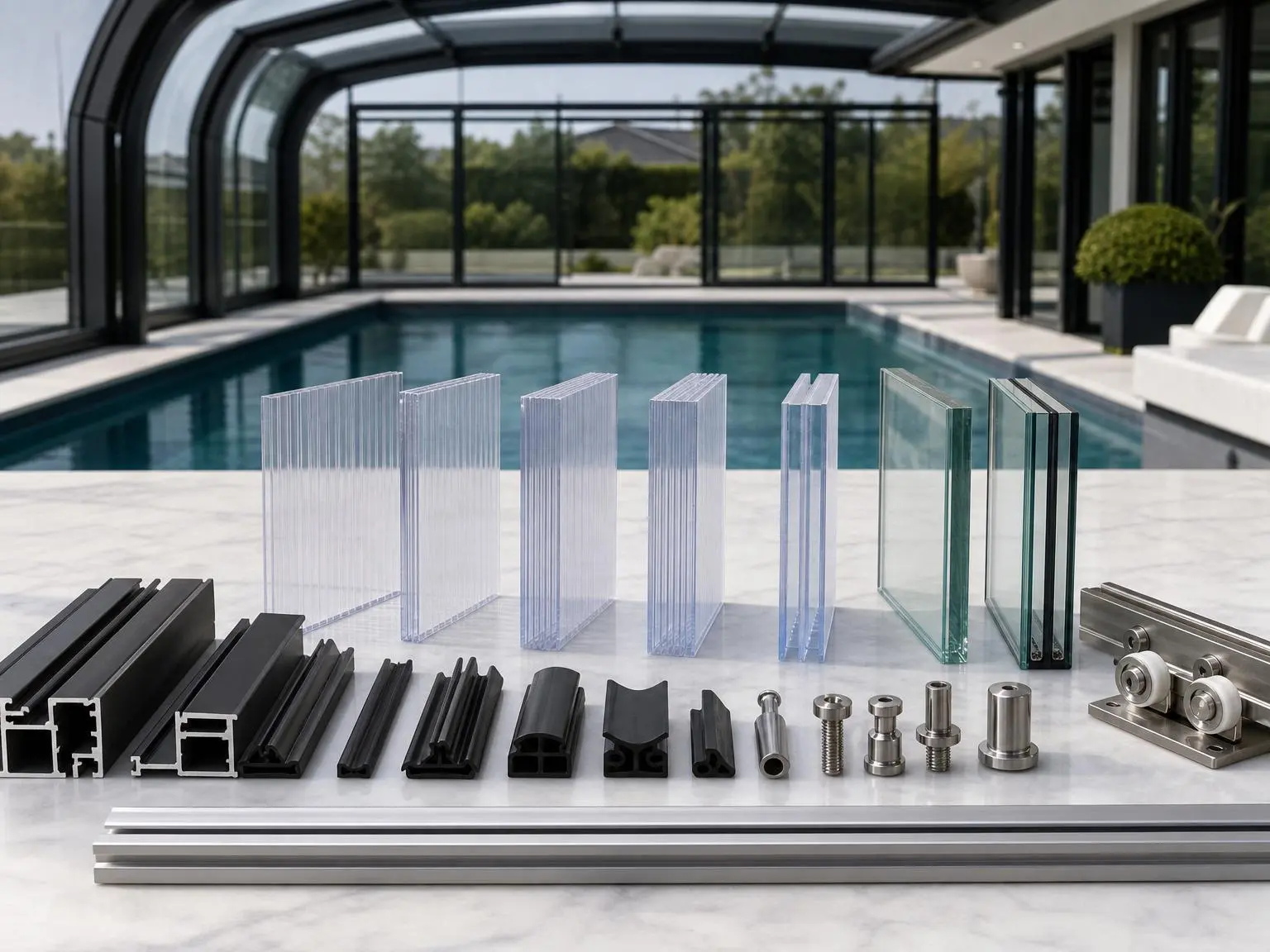
Glass vs Polycarbonate Pool Enclosures: Which Material Is Better for Your Pool Sunroom?
When planning a custom pool enclosure or pool sunroom, one of the most important material decisions is whether to use polycarbonate panels, laminated glass or insulated glass.
Both glass and polycarbonate can create a bright, transparent and weather-protected swimming pool space. However, they perform differently in weight, clarity, impact resistance, UV protection, insulation, sound control, cost, maintenance and suitability for retractable structures.
Sunrim designs and manufactures custom pool enclosures, pool sunrooms, أغطية حمامات السباحة القابلة للسحب and transparent aluminum outdoor enclosure systems for villas, hotels, resorts and commercial swimming pool projects worldwide.
For different projects, Sunrim can use 4–12mm polycarbonate panels, laminated glass or insulated glass, together with high-strength industrial aluminum frame structures. This guide explains how these materials compare and how to choose the right option for your pool enclosure or pool sunroom project.
Quick Answer: Is Glass or Polycarbonate Better for a Pool Enclosure?
Polycarbonate is usually better for أغطية حمامات السباحة القابلة للسحب because it is lightweight, impact-resistant, flexible and practical for sliding or telescopic structures. Sunrim commonly uses 4–12mm polycarbonate panels for custom retractable enclosure systems, depending on project requirements.
Glass is usually better for premium pool sunrooms where visual clarity, architectural appearance and a luxury indoor-outdoor experience are more important. Laminated glass or insulated glass may be selected for high-end villa, hotel or resort pool sunroom projects.
In simple terms, polycarbonate is often the practical choice for movable pool enclosure systems, while glass is often the premium choice for fixed or high-end pool sunroom spaces.
Why Material Selection Matters for Pool Enclosures
A pool enclosure is not a simple transparent cover. It is an outdoor architectural structure exposed to sunlight, rain, wind, humidity, pool chemicals, temperature changes and daily operation.
The panel material affects:
- Structure weight
- Frame strength requirements
- Sliding performance
- Visual clarity
- مقاومة الصدمات
- UV protection
- Heat insulation
- Sound insulation
- Anti-condensation performance
- Fire performance
- مدى تعقيد التركيب
- Maintenance requirements
- Long-term durability
- Overall project cost
For retractable pool enclosures, the material must also work with aluminum frames, sliding tracks, rollers, seals and optional motorized systems. This is why material selection should be based on the full enclosure system, not only the panel price.
Sunrim Pool Enclosure Material Options
Sunrim pool enclosure and pool sunroom systems can be customized with different transparent panel materials according to project needs.
Common panel options include:
- 4–12mm polycarbonate panels
- Laminated glass
- Insulated glass
- Clear panels
- Tinted panels
- Opal or translucent panels
- Custom color panel options for selected projects
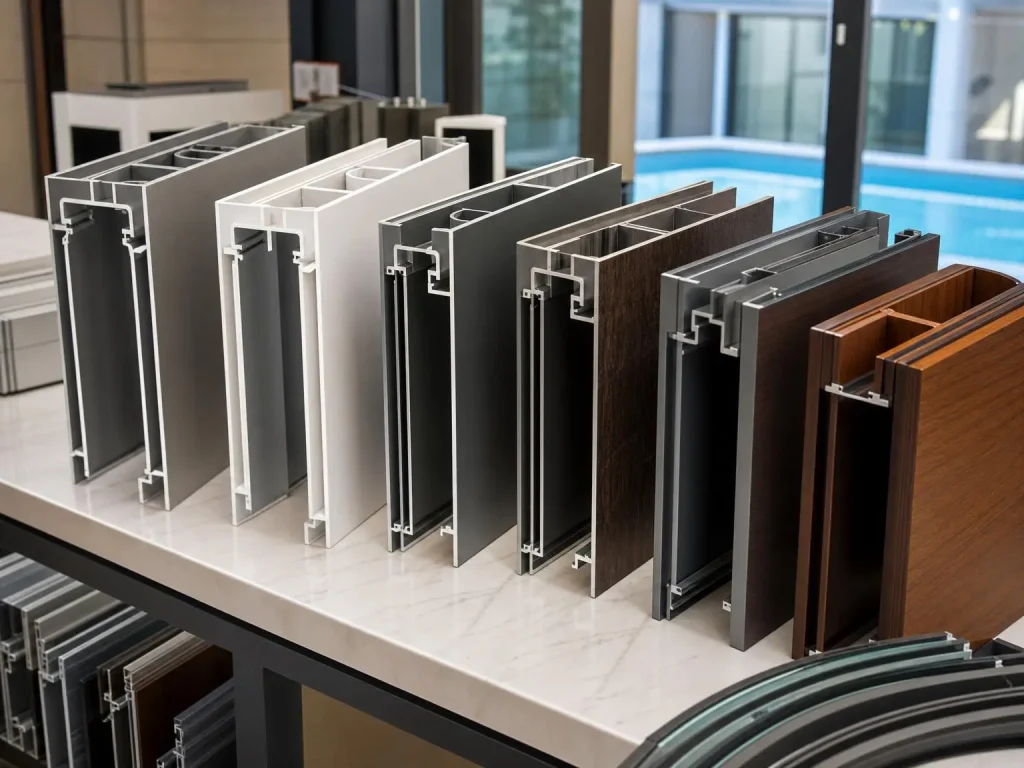
For frame structures, Sunrim uses high-strength industrial aluminum profiles. For standard structures, main beam profiles can be around 100 × 66mm with 3mm wall thickness. For larger structures, main beams can reach around 200 × 150mm with 4mm wall thickness, depending on engineering requirements.
Common frame finish options may include RAL 9006 silver grey, RAL 9010 white, DB 703, coffee brown, pine wood grain and other custom finishes.
These material and color options allow Sunrim pool enclosures to match different villas, hotels, resorts and commercial architectural styles.
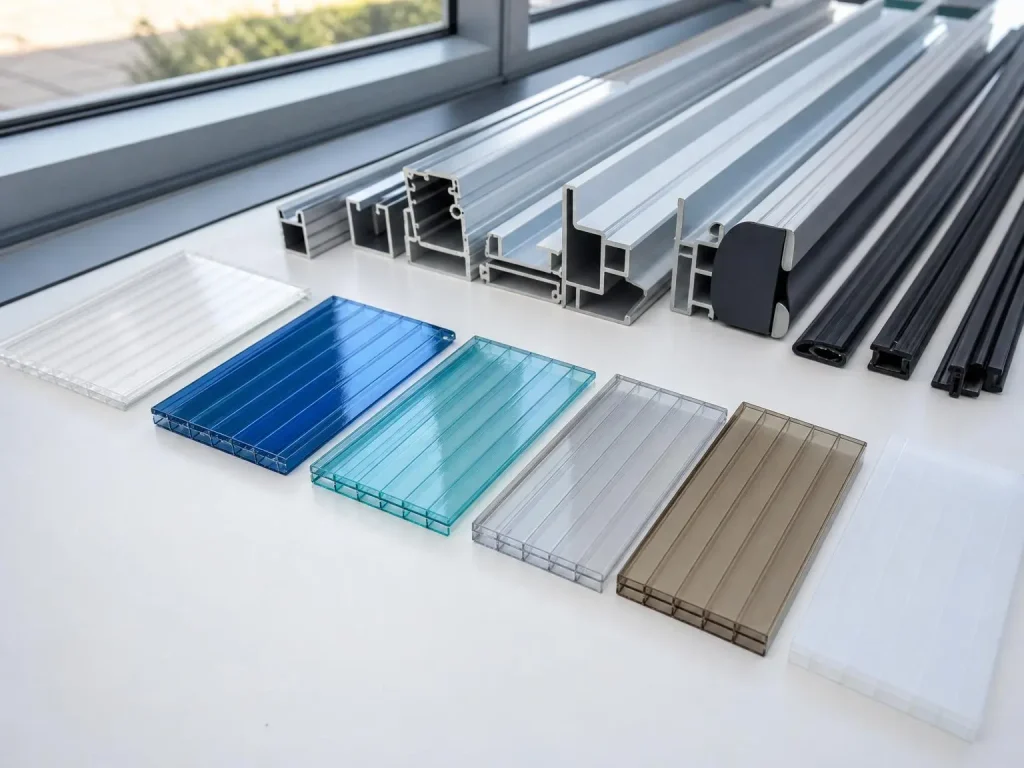
What Is a Polycarbonate Pool Enclosure?
A polycarbonate pool enclosure uses transparent or translucent polycarbonate panels installed within an aluminum frame structure.
Polycarbonate, also known as PC, is a high-performance thermoplastic material widely used in outdoor architectural panels because it is lightweight, impact-resistant, transparent, flame-retardant and suitable for curved or movable structures.
Sunrim can use 4–12mm polycarbonate panels for different pool enclosure and pool sunroom projects.
Polycarbonate panels are especially suitable for:
- Retractable pool enclosures
- Telescopic pool enclosures
- Low-profile pool enclosures
- Mid-height swimming pool enclosures
- Motorized pool enclosure systems
- Curved or arched enclosure structures
- Projects requiring lightweight movable sections
Key Advantages of Polycarbonate Panels
Polycarbonate panels offer several practical advantages for pool enclosure systems.
1. High Light Transmission
Quality polycarbonate panels can provide high light transmission. According to Sunrim material data, PC panels can reach up to around 89% light transmission, helping the pool enclosure maintain natural daylight.
UV-coated panels can also help reduce yellowing and haze caused by long-term sunlight exposure.
For outdoor applications, UV protection is important because pool enclosures are exposed to sunlight for many years.
2. Strong Impact Resistance
Impact resistance is one of the most important advantages of polycarbonate.
According to Sunrim material data, PC panels can have an impact strength around 250–300 times that of ordinary glass, around 30 times that of acrylic panels of the same thickness and about 2–20 times that of tempered glass depending on thickness and testing conditions.
This makes polycarbonate suitable for outdoor pool enclosures exposed to wind, hail, falling branches or daily use.
3. UV Protection and Anti-Condensation Options
Polycarbonate panels can be produced with UV-resistant coating. In some designs, one side may include UV protection while the other side may include anti-condensation treatment.
This helps improve:
- UV resistance
- Heat performance
- Anti-drip performance
- Comfort inside the pool enclosure
- Protection of furniture or poolside finishes
For pool sunrooms in hot or sunny regions, UV protection should be considered carefully.
4. Flame-Retardant Performance
Polycarbonate panels can offer flame-retardant performance. According to Sunrim material data, PC panels can meet B1 flame-retardant classification under relevant project conditions.
PC material has a relatively high ignition point and can self-extinguish after leaving the fire source, depending on material specification.
For hotels, resorts and commercial pool enclosure projects, fire performance should be reviewed according to local regulations and project requirements.
5. Bendability for Curved Designs
Polycarbonate panels can be cold-bent on site or during installation according to design requirements. This makes them suitable for arched roofs, curved pool enclosures and semi-circular roof structures.
The minimum bending radius may be around 175 times the panel thickness, depending on panel type and engineering requirements.
This flexibility is important for retractable pool enclosures because many telescopic or low-profile systems use curved roof shapes.
6. Sound Insulation Performance
Polycarbonate panels can also provide sound insulation benefits. According to Sunrim material data, PC panels may improve sound insulation by around 3–4 dB compared with glass of similar thickness under certain conditions.
For hotel, resort or commercial pool areas, sound comfort may be one factor in material selection.
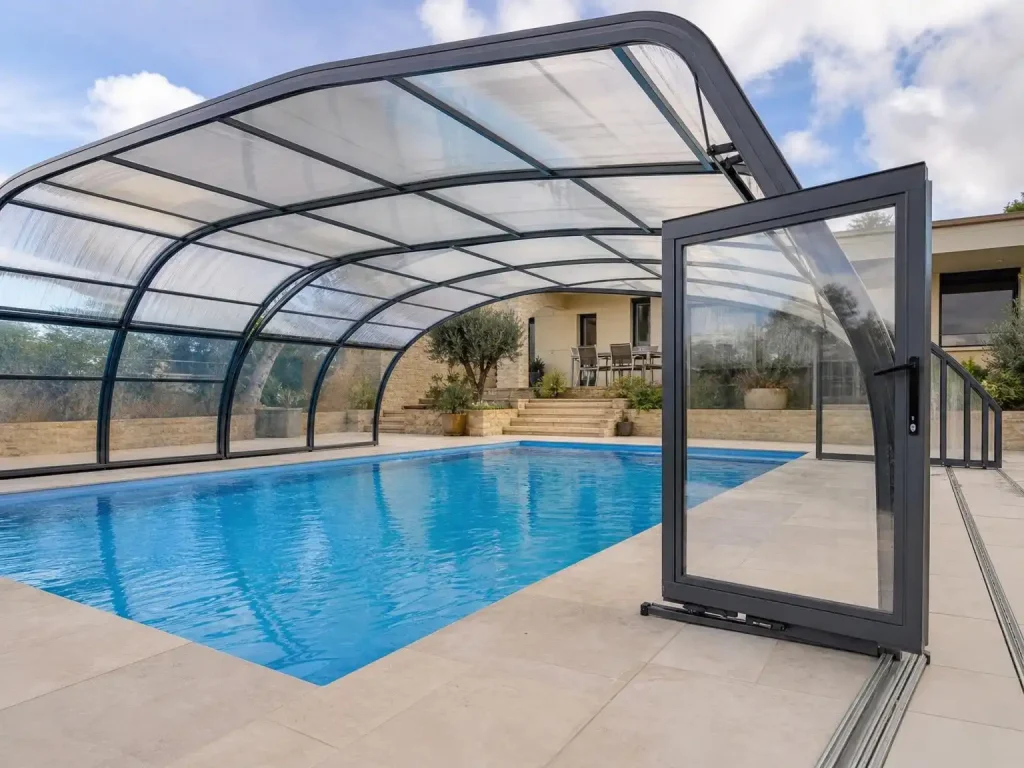
What Is a Glass Pool Enclosure?
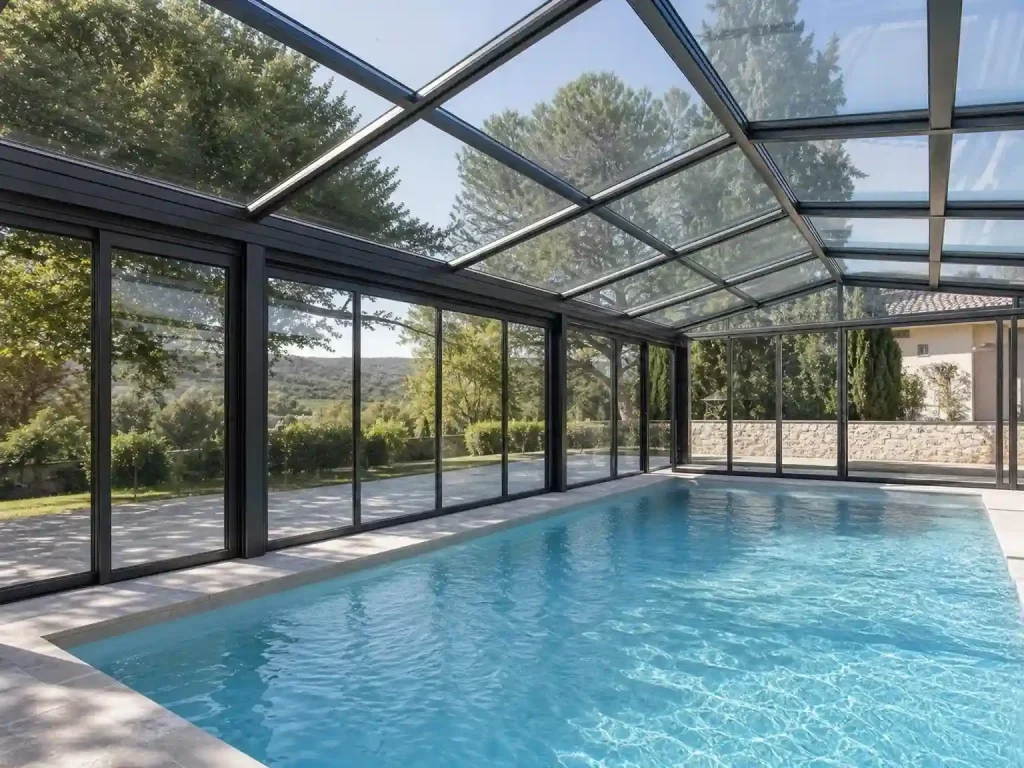
A glass pool enclosure uses glass panels installed within an aluminum or structural frame system.
Glass is often selected for high-end pool sunrooms, luxury villa pools, hotel swimming pools and premium resort projects because it provides excellent visual clarity and a more architectural appearance.
Common glass options may include:
- Laminated glass
- Insulated glass
- Tempered glass depending on project requirements
- Tinted glass
- Clear glass
- Low-E or coated glass in selected applications
Glass provides a premium look, but it is heavier than polycarbonate. This means the supporting frame, foundation, installation method and safety requirements must be considered carefully.
For pool sunrooms where visual quality is the top priority, glass can be a strong choice.
Glass vs Polycarbonate Pool Enclosures: Main Differences
| العامل | Polycarbonate Pool Enclosure | Glass Pool Enclosure |
|---|---|---|
| Typical Sunrim option | 4–12mm PC panels | Laminated glass or insulated glass |
| Weight | خفيف الوزن | Heavy |
| مقاومة الصدمات | Very strong | Strong with safety glass, but heavier and breakable |
| Visual clarity | جيد | Excellent |
| التكلفة | عادةً ما يكون أقل | عادةً ما تكون أعلى |
| Structure requirement | Lighter frame possible | Stronger frame required |
| Retractable suitability | مناسب جدًّا | Possible but more complex |
| Curved design | Easier to cold-bend | More limited |
| UV protection | Available with UV coating | Depends on glass type |
| Anti-condensation | Available in selected PC panel designs | Depends on glass system |
| Sound insulation | Good practical performance | Good, especially with laminated or insulated glass |
| الأفضل لـ | Retractable pool enclosures, telescopic systems, practical projects | Pool sunrooms, luxury villas, hotels, resorts |
| مدى تعقيد التركيب | من منخفض إلى متوسط | أعلى |
| Long-term appearance | Good with quality UV protection | Excellent with proper cleaning |
1. Weight and Retractable Performance
Weight is one of the biggest reasons polycarbonate is widely used in retractable pool enclosures.
Because polycarbonate is much lighter than glass, it is easier to use in sliding, telescopic and motorized systems.
A lighter panel can reduce:
- Load on aluminum frames
- Roller stress
- Track pressure
- Motor load
- Installation difficulty
- Shipping weight
- Structural reinforcement requirements
Glass is heavier, which means a glass pool enclosure usually needs stronger aluminum profiles, stronger support, more careful engineering and more installation coordination.
For large retractable pool enclosures, polycarbonate is often more practical. For fixed or semi-fixed luxury pool sunrooms, glass may be suitable if the structure is properly engineered.
2. Transparency and Architectural Appearance
Glass provides excellent optical clarity. If your project requires a premium architectural look, clear reflections and a high-end indoor-outdoor experience, glass usually performs better.
This makes glass suitable for:
- Luxury villa pool sunrooms
- Boutique hotel pool spaces
- Resort pool lounges
- Premium wellness centers
- Architectural showcase projects
Polycarbonate also provides good transparency, especially clear PC panels. It may not look as optically pure as glass, but it is often more practical for movable systems.
Sunrim panel color options may include:
- Clear
- Sapphire blue
- Green blue
- Silver
- Tan
- Opal
- Custom colors for selected projects
These color choices can help manage glare, privacy, heat comfort and architectural appearance.
3. Impact Resistance and Safety
Polycarbonate is highly impact-resistant and is often chosen for environments where outdoor durability is important.
وهو مناسب لـ:
- Windy locations
- Areas with falling leaves or branches
- Pool areas with frequent use
- Residential family pools
- Commercial leisure spaces
- Retractable or telescopic systems
Glass can also be safe when laminated or tempered safety glass is selected. However, glass can break under severe impact and requires more careful structural design.
For pool enclosures that need frequent opening and closing, polycarbonate is usually the safer and more practical material choice.
4. UV Protection and Outdoor Durability
Outdoor pool enclosures are exposed to sunlight for long periods. UV protection is very important for polycarbonate panels.
According to Sunrim material data, UV-coated PC panels can maintain good light transmission after long-term exposure, with limited light transmission loss under specified conditions.
When evaluating polycarbonate panels, buyers should ask:
- What is the panel thickness?
- Is the panel UV-protected?
- Is anti-condensation treatment available?
- What color options are available?
- Is the panel suitable for hot and sunny climates?
- What is the expected outdoor service life?
Glass does not yellow like low-quality plastic materials, but heat control, glare and insulation depend on the selected glass type.
For hot regions such as the Middle East, Australia, southern Europe and sunny areas of the United States, UV resistance and heat comfort should be carefully considered.
5. Insulation and Anti-Condensation Performance
Pool enclosures often face moisture and temperature differences. This makes insulation and condensation management important.
Polycarbonate panels can provide practical insulation performance, especially hollow or multi-wall structures. In selected designs, anti-condensation treatment can help reduce dripping and improve comfort.
Glass can also provide insulation when insulated glass is selected. However, insulated glass is heavier and more expensive.
For cold or humid climates, material selection should be considered together with:
- التهوية
- الصرف
- Sealing
- انحدار السقف
- Local temperature range
- Pool water humidity
- الوصول لأغراض الصيانة
For pool sunrooms, comfort depends on the whole system, not only the panel material.
6. Cost Comparison
Polycarbonate pool enclosures usually cost less than glass pool enclosures because the material is lighter and often requires a less heavy structural system.
Polycarbonate may reduce cost in:
- مادة اللوحة
- Frame reinforcement
- Shipping weight
- Installation labor
- Motor load
- Curved roof construction
Glass pool enclosures usually cost more because they may require:
- Higher material cost
- Stronger aluminum frame structure
- More careful engineering
- Heavier packaging
- Higher transport protection
- More complex installation
- Safety glass requirements
However, glass may justify the higher cost for luxury hotels, resorts and villa pool sunrooms where appearance and guest experience are very important.
7. Frame Structure and Color Options
The frame structure is just as important as the panel material.
Sunrim uses high-strength industrial aluminum profiles for pool enclosure and pool sunroom systems. For standard structures, main beam profiles can be around 100 × 66mm with 3mm wall thickness. For larger structures, main beams can reach around 200 × 150mm with 4mm wall thickness, depending on design and engineering requirements.
Common frame finish options may include:
- RAL 9006 silver grey
- RAL 9010 white
- DB 703
- Coffee brown
- Pine wood grain
- Custom finishes
Frame color should be selected according to the building style, landscape, climate and long-term maintenance expectations.
For coastal environments, corrosion resistance and hardware selection should also be considered.
8. Best Material for Retractable Pool Enclosures
For retractable pool enclosures, polycarbonate is usually the most practical choice.
It is suitable because it is:
- خفيف الوزن
- مقاوم للصدمات
- Easier to move
- Suitable for telescopic systems
- Suitable for curved roof sections
- More cost-effective
- Easier to ship and install
- Compatible with manual or motorized operation
If the project requires a high-end visual effect, glass may be used in selected fixed side walls or premium sections, while polycarbonate can be used for movable roof parts.
9. Best Material for Pool Sunrooms
For pool sunrooms, both glass and polycarbonate can work.
Choose polycarbonate if the project needs:
- Lower structural weight
- Retractable operation
- Better cost control
- مقاومة الصدمات
- Curved roof design
- Large movable sections
- Practical installation
Choose glass if the project needs:
- Premium transparency
- Luxury appearance
- Clear outdoor views
- A more permanent room-like feeling
- Hotel or resort guest experience
- High-end villa architectural value
For many projects, a hybrid solution can be a good option.
10. Can Glass and Polycarbonate Be Used Together?
Yes. Some custom pool enclosure and pool sunroom projects can use glass and polycarbonate together.
على سبيل المثال:
- Glass side walls with polycarbonate roof panels
- Glass doors with polycarbonate sliding sections
- Polycarbonate curved roof with glass viewing areas
- Glass pool sunroom structure with retractable polycarbonate modules
- Insulated glass in fixed areas and PC panels in movable areas
Hybrid designs can help balance:
- المظهر
- Weight
- التكلفة
- السلامة الإنشائية
- Retractable operation
- UV protection
- Climate performance
Sunrim can evaluate whether a hybrid material solution is suitable based on your pool size, project location, climate and budget.
11. Climate-Based Material Recommendations
Different climates require different material priorities.
المناطق الحارة والمشمسة
For the Middle East, Australia, southern Europe and sunny areas of the United States, UV protection, ventilation and heat comfort are important.
UV-coated polycarbonate panels or suitable tinted panel colors may be considered.
المناطق الباردة أو الثلجية
For Canada, northern United States, Germany, Switzerland and northern Europe, snow load, insulation, condensation and sealing should be reviewed carefully.
Polycarbonate can reduce structural weight, while glass requires stronger support and more detailed engineering.
المناطق الممطرة والرطبة
For the United Kingdom, Singapore, Malaysia, Thailand and Florida, drainage, ventilation and anti-condensation performance are important.
PC panels with anti-condensation treatment may be considered depending on project requirements.
المناطق الساحلية
For coastal Australia, New Zealand, Mediterranean regions and coastal United States, corrosion resistance is important.
Aluminum surface treatment, stainless steel hardware and regular maintenance may be more important than the panel material alone.
How Sunrim Helps Choose Pool Enclosure Materials
Sunrim designs and manufactures custom pool enclosures, pool sunrooms, retractable pool enclosures and outdoor enclosure systems for global residential, hospitality and commercial projects.
Sunrim can help evaluate:
- Pool size and shape
- ارتفاع الحاوية
- Fixed, retractable or telescopic design
- 4–12mm polycarbonate panel options
- Laminated glass or insulated glass options
- هيكل من الألومنيوم
- Panel color selection
- Frame color selection
- Local wind and snow load
- التعرض للأشعة فوق البنفسجية
- Humidity and rainfall
- خطر التآكل الساحلي
- التشغيل اليدوي أو الآلي
- طريقة التركيب
- Budget and project positioning
Instead of recommending one material for every project, Sunrim provides project-based material suggestions according to real site conditions and long-term use requirements.
What Information Should You Send for Material Recommendations?
To receive a practical material recommendation, prepare the following information:
- موقع المشروع
- طول المسبح وعرضه
- شكل المسبح
- الارتفاع المطلوب للحاوية
- Pool enclosure or pool sunroom preference
- Fixed, retractable or telescopic design preference
- تفضيل التشغيل اليدوي أو الآلي
- الظروف المناخية المحلية
- الرياح، والثلج، والمطر، والحرارة، أو التعرض للعوامل الساحلية
- Preferred appearance level
- Panel color preference
- تفضيل لون الإطار
- نطاق الميزانية (إن وجد)
- Site photos and videos
- توافر المقاولين المحليين
With this information, Sunrim can recommend whether polycarbonate, glass or a hybrid solution is more suitable.
Conclusion: Glass or Polycarbonate for Your Pool Enclosure?
Both glass and polycarbonate can be used for pool enclosures and pool sunrooms, but they are suitable for different project needs.
Polycarbonate is usually better for retractable pool enclosures because it is lightweight, impact-resistant, bendable and practical for sliding or telescopic operation. Sunrim commonly uses 4–12mm polycarbonate panels for custom retractable enclosure systems.
Glass is usually better for premium pool sunrooms where visual clarity, luxury appearance and architectural value are priorities. Laminated glass or insulated glass may be selected for high-end villas, hotels and resort pool spaces.
For many custom projects, the best solution may combine aluminum frames with polycarbonate panels, glass panels or hybrid panel systems.
Sunrim provides custom pool enclosure and pool sunroom solutions using high-strength aluminum frames and project-specific transparent panel options according to pool size, climate, design style and installation requirements.
Need Help Choosing Glass or Polycarbonate for Your Pool Enclosure?
Sunrim designs and manufactures custom pool enclosures, pool sunrooms and retractable pool enclosure systems for villas, hotels, resorts and commercial swimming pools worldwide.
Send us your pool size, project location, site photos and design requirements. Our team can help recommend the right material, frame structure and color options for your pool enclosure project.
Contact Sunrim to discuss your custom pool enclosure or pool sunroom solution.
FAQ About Glass and Polycarbonate Pool Enclosures
أيهما أفضل لتغطية حوض السباحة: الزجاج أم البولي كربونات؟
Polycarbonate is usually better for retractable pool enclosures because it is lightweight, impact-resistant and suitable for sliding or telescopic structures. Glass is better for premium pool sunrooms where visual clarity and luxury appearance are more important.
What polycarbonate thickness does Sunrim use for pool enclosures?
Sunrim can use 4–12mm polycarbonate panels for pool enclosure and pool sunroom systems, depending on project size, enclosure type, climate and engineering requirements.
Is polycarbonate strong enough for a retractable pool enclosure?
Yes. Polycarbonate has very strong impact resistance and is widely used in retractable pool enclosures, telescopic pool enclosures and outdoor enclosure systems.
Does polycarbonate have UV protection?
Yes. UV-protected polycarbonate panels can be used for outdoor pool enclosures to help reduce yellowing, haze and long-term sunlight damage.
Can polycarbonate panels be curved?
Yes. Polycarbonate panels can be cold-bent according to design requirements, making them suitable for arched roofs, curved pool enclosures and telescopic enclosure structures.
Is a glass pool enclosure more expensive than polycarbonate?
Yes. A glass pool enclosure is usually more expensive because glass is heavier and often requires stronger aluminum frames, more careful engineering, heavier packaging and more complex installation.
What glass options can be used for pool sunrooms?
Depending on project requirements, pool sunrooms may use laminated glass, insulated glass or other safety glass options.
Can glass and polycarbonate be used together?
Yes. Some custom pool enclosure projects use glass side walls with polycarbonate roof panels or combine fixed glass areas with movable polycarbonate sections.
What colors are available for Sunrim pool enclosure panels?
Sunrim panel color options may include clear, sapphire blue, green blue, silver, tan, opal and selected custom colors.
What frame colors are available for Sunrim pool enclosures?
Common Sunrim frame finish options may include RAL 9006 silver grey, RAL 9010 white, DB 703, coffee brown, pine wood grain and custom finishes.
What aluminum frame does Sunrim use?
Sunrim uses high-strength industrial aluminum profiles for pool enclosure and pool sunroom structures. Main beam dimensions and wall thickness are selected according to project size and engineering requirements.
Does Sunrim provide material recommendations for each project?
Yes. Sunrim provides project-based material recommendations according to pool size, enclosure type, local climate, design style, budget and installation requirements.


